James Webb Telescope Discovers Ancient Mixed Ice Around Young Star Beta Pictoris
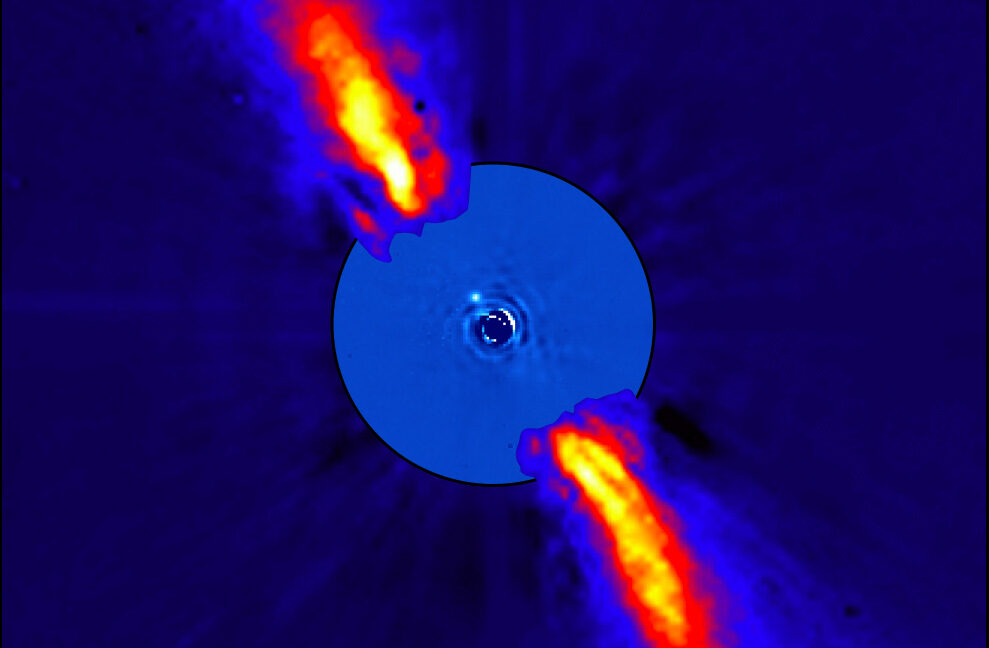
Astronomers using the James Webb Space Telescope have detected glassy water and carbon dioxide ice within the debris disk of the young star Beta Pictoris.
 🧠AI Analysis
Photo: arstechnica.com
Key points
- James Webb Space Telescope detected water and carbon dioxide ice around Beta Pictoris.
- The ice is in a glassy, amorphous state with carbon dioxide trapped inside water grains.
- The chemical proportions closely mirror those found in comets within our own Solar System.
Researchers studying the 20-million-year-old star Beta Pictoris have identified both water and carbon dioxide ice inside its surrounding debris disk using the James Webb Space Telescope. Located roughly 64 light-years away, the system contains a vast ring of dust and rubble where planetary formation is actively underway. While previous attempts to detect water vapor and basic ice signatures yielded no results, observations conducted on December 7, 2023, with Webb’s Near Infrared Spectrograph successfully bypassed the blinding glare of the star.
The scientific team, led by Sarah Betti at the Space Telescope Science Institute, discovered that the water ice is in an amorphous, glassy state rather than a crystalline structure. Furthermore, spectral analysis revealed that carbon dioxide molecules are thoroughly trapped inside the water ice grains rather than existing separately. This composite structure forms a durable dirty ice capable of withstanding the harsh ultraviolet radiation emitted by the young host star.
Calculations show that roughly one carbon dioxide molecule exists for every ten water molecules, placing the ratio at approximately 11 percent. This proportion closely mirrors measurements recorded from comets in our own Solar System and other newborn stellar disks. Such consistency indicates that the fundamental building blocks necessary for constructing water-rich worlds may be broadly shared across different planetary systems during early formation stages.
Source arstechnica.com — arstechnica.com/science/2026/11/james-webb-telescope-finds-ice-older-th… ↗
Read next
 ⌚Wearables
Apple Launches Health AI Study App for iPhone and Apple Watch Users
Apple has rolled out a dedicated application for its new Health AI Study, inviting US users to examine how people interact with conversational medical tools.
 💻Laptops & PCs
How to clear app caches on your Mac to free up storage and fix glitches
Learn when and how to manually clear application caches on your macOS device to reclaim valuable storage space and troubleshoot software glitches.
 🏠Smart Home
Area Launches Stakuri Plus: A Compact Phone Stand Packed With 17 Cleaning Tools
Japanese brand Area has released the Stakuri Plus, a portable smartphone stand that doubles as a comprehensive 17-in-1 electronics cleaning kit for roughly $16.
 🧭Buying Guides
Cloud vs. Local Storage: Which Backup Method Fits Your Gadgets Best?
A detailed comparison of cloud storage services like iCloud and Google Drive versus physical local drives, weighing access, costs, and reliability.
 🧭Buying Guides
Zelda: Ocarina of Time Remake Review Sparks Metacritic Debate
A single mixed review for the upcoming Zelda: Ocarina of Time remake on the Switch 2 has dropped its Metascore from 96 to 95, igniting backlash from fans.
 📱Phones
Understanding Sudden Phone Battery Drops: Causes and Fixes
Experiencing rapid battery percentage drops on your phone can be frustrating, but the issue usually stems from aging lithium-ion cells, background software processes, or …